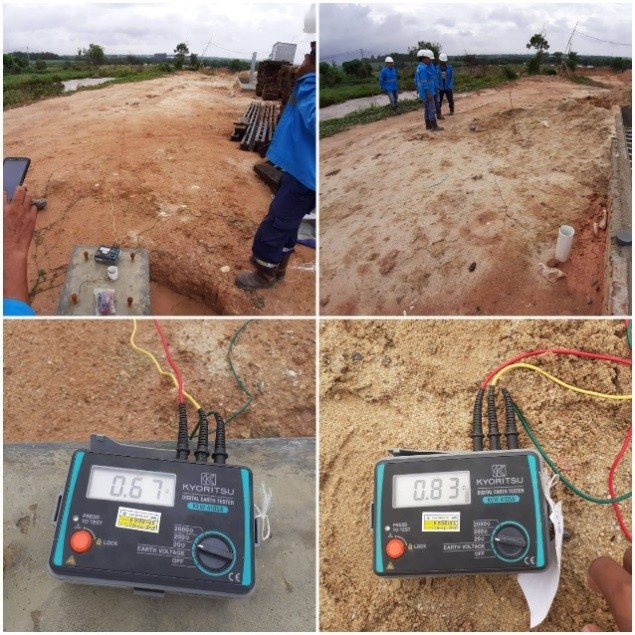
Evaluating Grounding Grid Safety in Renewable Energy Facilities Based on IEEE Std 80-2013 Using Spatial Voltage Distribution Modeling: A Case Study of Terbanggi Ilir Biogas Power Plant, Central Lampung
DOI:
https://doi.org/10.47355/jaset.v6i1.117Keywords:
Grounding grid, Finite Element Method, IEEE Std 80, Touch potential, Step potential, Biogas power plantAbstract
Grounding grids in renewable energy facilities, such as biogas power plants, are critical for personnel safety and equipment protection during ground faults. This study evaluates the safety performance of the grounding grid at Terbanggi Ilir Biogas Power Plant in Central Lampung to validate its compliance with safety standards. Using the Finite Element Method (FEM) within Python Numerical Computation, 3D and 2D spatial voltage distribution profiles of the plant's asymmetric grounding grid—comprising 71 horizontal conductor (70 mm2) and 9 vertical rods (24 m) embedded in a two-layer soil model with a 0.2 m gravel surface layer—were simulated under a 25 kA fault current. The grid achieved a low resistance of 0.967 ohm, limiting the ground potential rise to 11.966 kV. The maximum calculated touch potential of 3.629 kV and step potential of 1.775 kV were both safely below the tolerable limits of 4.305kV and 16.555kV respectively, determined by IEEE Std 80 guidelines. The study concludes that the custom-tailored grid layout effectively mitigates electrical hazards, demonstrating that spatial voltage distribution modeling is vital for verifying earthing grid integrity in biogas power plant facilities.
References
Smith, J.A.; Johnson, R.B. Global Renewable Energy Transition and Bioenergy Systems; Academic Press: New York, NY, USA, 2021; pp. 45–60.
Prabowo, A.; Siregar, H. Utilization of Agro-Industrial Waste for Decentralized Biogas Plants in Sumatra. J. Renew. Energy Dev. 2023, 12, 112–125.
Hans, M. Electrical Safety and Grounding Hazards in Industrial Power Systems; Wiley-IEEE Press: Piscataway, NJ, USA, 2018; pp. 200–215.
Taylor, P.F. Personnel Protection and Risk Assessment in High-Voltage Facilities. IEEE Trans. Power Deliv. 2020, 35, 1420–1431.
IEEE Guide for Safety in AC Substation Grounding; IEEE Std 80-2013 (Revision of IEEE Std 80-2000); IEEE: Piscataway, NJ, USA, 2013; pp. 1–226.
Schwarz, S.J. Analytical Expressions for the Resistance of Grounding Grids. AIEE Trans. Power Appar. Syst. 1954, 73, 1011–1016.
Al-Arainy, A.A.; Malik, N.H. Comparative Study between Analytical and Numerical Methods in Grounding Grid Designs. Electr. Power Syst. Res. 2019, 174, 105–118.
Zhang, L.; Chen, J.; Wang, Y. Identifying Hot Spots and Spatial Voltage Gradients in Asymmetric Grounding Grids. IEEE Trans. Ind. Appl. 2021, 57, 3340–3351.
Takahashi, K.; Kawase, T. Analysis of Grounding Grids in Stratified Multi-Layer Soil Profiles. IEEE Power Eng. Rev. 2022, 22, 54–59.
Martinez, J.D. Mitigation of Touch and Step Potentials Using High-Resistivity Surface Gravel Layers. Int. J. Electr. Power Energy Syst. 2020, 115, 105–112.
He, J.; Zeng, R. Methodology of Substation Grounding; Science Press: Beijing, China, 2021; pp. 180–205.
Lee, K.H.; Kim, T.O. Finite Element Modeling of Soil Stratification and Grounding Grid Performance. IEEE Trans. Magn. 2022, 58, 1–8.
C. F. Dalziel, "Electric Shock Hazard," IEEE Spectrum, vol. 9, no. 2, pp. 41-50, Feb. 1972.
J. D. Martinez and A. Gomez, "Analysis of surface layer reflection factors in substation grounding," Electric Power Systems Research, vol. 115, pp. 105-112, 2020.
ETAP, Ground Grid Systems User Guide, Enterprise Solution v12.6.0, Operation Technology, Inc., 2019.