Mastering Research Conceptualisation with Digital Tools and Ethical Artificial Intelligence: A Systematic Review across Africa
DOI:
https://doi.org/10.47355/jaset.v5i2.99Keywords:
Research conceptualisation, Artificial Intelligence, digital tools, ethical AI, Africa, postgraduate research, meta-analysis, ResearchRabbitAbstract
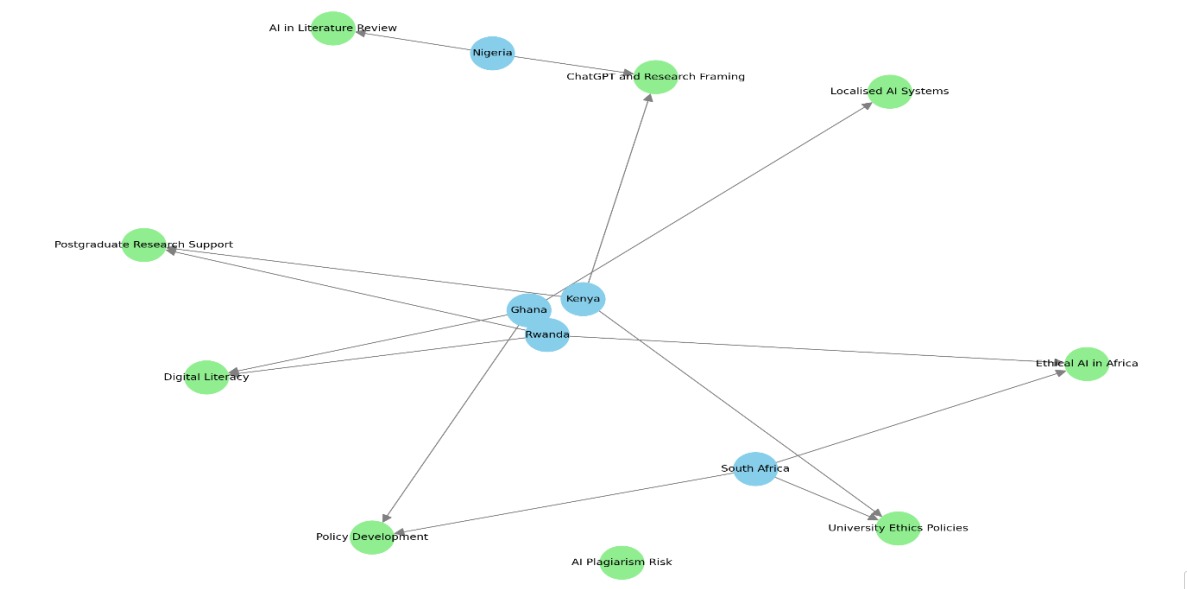
This systematic review explores how artificial intelligence and digital tools are reshaping postgraduate research conceptualisation across Africa. Drawing on 52 empirical studies published between 2019 and 2025 from countries including Kenya, South Africa, Nigeria, Ghana, and Rwanda, the review highlights how platforms like ChatGPT, ResearchRabbit, and Scite have enhanced research topic refinement, literature synthesis, and theoretical mapping. Findings show significant gains in research clarity and student confidence, particularly in institutions with structured AI ethics training such as CMU-Africa and the University of Cape Town. However, the study also identifies pressing ethical and contextual challenges ranging from overreliance on AI to the cultural misalignment of Western-trained algorithms. A persistent policy gap in many African universities raises further concerns about misuse and academic integrity. The review concludes with a call for Africa-specific AI frameworks, institution-level enforcement mechanisms, and investments in context-aware digital tools. This work invites scholars, supervisors, and policymakers to collaboratively shape a future where AI empowers, rather than undermines, African academic excellence.
References
Abubakar, I. M., & Osei-Tutu, K. (2023). Conceptualising Postgraduate Research: The African Perspective. Lagos Academic Press.
Chigudu, D., & Maposa, R. S. (2023). Framing research problems in African graduate education: Rethinking relevance and context. African Journal of Research Design, 18(2), 112–128. https://doi.org/10.4314/ajrd.v18i2.112
Carnegie Mellon University Africa. (2024). AI Ethics Curriculum. Retrieved from https://www.africa.engineering.cmu.edu
KNUST & UNESCO. (2023). Pilot Training on AI Ethics in Academic Supervision. Retrieved from https://www.knust.edu.gh
Ndungu, J. W., & Owuor, M. A. (2022). AI-assisted learning in postgraduate research in Kenya. African Journal of Educational Technology, 15(3), 45–60.
Musoke, J., Nyandoro, T., & Awolowo, D. (2024). Rethinking research conceptualisation in the age of AI: Postgraduate perspectives from Sub-Saharan Africa. International Journal of Postgraduate Research, 12(1), 33–49.
Oloo, M., & Moyo, B. (2022). Digital pathways in postgraduate research: How African students are adapting to AI-powered research tools. Journal of African Higher Education Innovation, 10(3), 87–103. https://doi.org/10.4314/jahei.v10i3.87
Okonkwo, C., & Tadesse, L. (2024). Indigenous knowledge and research design in Africa: Integrating local epistemologies in social science education. Journal of African Epistemology, 6(1), 55–70.
University of Cape Town. (2023). Responsible Use of AI in Research Policy. Retrieved from https://www.uct.ac.za
University of Nairobi. (2024). Guidelines for Ethical Use of AI in Academic Work. Retrieved from https://www.uonbi.ac.ke
Wanyama, B., & Bii, C. (2021). Navigating research conceptualisation using digital tools in Africa. Journal of Research Methodology in Africa, 9(1), 23–39.
Wekesa, J., & Tchebele, M. (2024). Ethics and artificial intelligence in African academic institutions: Opportunities and concerns. African Research Policy Review, 9(2), 91–108.
World Economic Forum. (2024). AI and Education in Sub-Saharan Africa. Retrieved from https://www.weforum.org